 ABOUT THIS GUIDE
Welcome to the CSLP Community-Based Summers Guide. This resource is for library staff who want to engage community voices and provide inclusive summer services for all. It is useful both for those who are totally new to design, planning, and implementation of summer services and for experienced planners who want tools and inspiration to make their summer services more community-based and inclusive.
This Guide covers:
- The value of knowing your Why for summer services. This can help you to design activities and services that are just right for your local community, and that bring in the voices of those who are not already connected to the library.
- How to get started thinking about re-imagining summer traditions. Even if you are new to summer library programs and services, it’s likely that there are ways these services have always been delivered. Instead of simply continuing to do the same thing this year, consider how the traditions do and don’t support your summer Why, and how you might re-imagine what’s always been done to guarantee that what is implemented is community-centered.
- The importance of working with community members and groups who are not already connected to the library and who may be experiencing marginalization. Without bringing in the voices of those in the community who are not already library (and summer library) users you have a better chance of making sure you harness the strengths and address the challenges of those groups during the summer.
- Ways in which you can begin to think about what your goals for summer are, how they support your summer Why, and ways in which you can look for progress towards those goals.
_______________________________________________________________________________________________________________________________
 Start with Your Summer Why
Before planning any programs, events, or calendars, it’s worth pausing to ask:
Why does your library offer summer services at all?
That simple question lays the foundation for everything that comes next. It’s what helps you make intentional decisions instead of defaulting to the way things have always been done. Your “Why” is the purpose—the meaningful reason behind summer services. And ideally, that purpose reflects community needs, values, and goals, especially for those who are often left out of library planning.
Why the “Why” Matters
Without a clear Why, it’s easy to focus on logistics:
- When is the summer reading kick-off?
- Do we have enough performers?
- How many reading logs do we need to print?
But with a strong Why, priorities shift. You start to ask questions like:
- What helps kids and families feel connected this summer?
- What helps build trust with groups who aren’t connected to the library?
- What are we authentically trying to achieve this summer?
A Sample Why in Action
Let’s say your library decides on this summer Why: “To help youth and adults build relationships with each other.”
Now, imagine you’re reviewing your typical summer activities. Ask yourself:
- Does our registration process help people build relationships—or is it just paperwork?
- Do our events intentionally give youth and adults opportunities for relationship building?
- Could we co-host something with a neighborhood group to create more connection?
By holding everything up to your Why, you begin to design intentionally, not automatically.
The “5 Whys” Tool: Dig Deeper
Sometimes the first Why you come up with is too broad or too vague. Try this activity to get to the real purpose behind your Why.
Here’s how it works:
- Write your initial Why:
Example: “To bring people into the library” - Ask: Why is that important?
Because: “Over the summer youth and families often need a place to go to be a part of a community” - Ask again: Why is that important?
Because: “Being a part of a community is essential to gaining a sense of belonging” - Ask again: Why is that important?
Because: “A sense of belonging helps youth and adults build confidence” - Ask again: Why is that important?
Because: “Confidence leads to a sense of agency and independence.”
Keep in mind, the five whys each connect to each other. They are not separate ideas in a list. By connecting one to the other you are able to authentically consider a deeper summer Why.
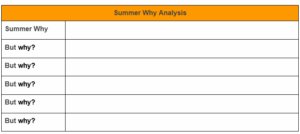
Use our 5 Whys template to dig into your own library’s Why:
 Letting Go of—and Reimagining—Traditions
Whether you’re brand new to summer services or have been part of them for years, it’s helpful to understand one thing: Summer library programs often carry a lot of tradition.
These might include:
-
-
-
-
-
-
- Reading logs
- Prizes & incentives
- Performers
- Kick-off parties or wrap-ups
-
-
-
-
-
A lot of traditions are fun and effective. Others may be outdated or even unintentionally exclude people. That’s why it’s important to look closely at your traditions—and see if they still serve your Why.
What Is a Tradition?
A tradition is simply “something we’ve always done”—even if we don’t remember why. In many libraries, summer traditions go back decades, often without much reflection. As this podcast highlights, many of these ideas (like giving prizes for reading) come from older systems built around control, not community.
So, what happens if we pause and ask:
“Why do we do this?”
“Does it help us reach our summer goals?”
“Who benefits from it—and who’s left out?”
Try This: Review a Tradition with the “Why” Lens
Choose one familiar practice—like registration—and ask your team:
| Question | Your Notes |
| What are we doing? | (e.g., “We require families to register”) |
| Why do we do it this way? | (e.g., “We’ve always done it this way,” or “To track participation” or “To report numbers the State Library is looking for.”) |
| Who benefits from this? | (e.g., “Families who are already connected to the library” “The library benefits by having something familiar to work on” or “The State Library benefits by having data they can use in reports”) |
| Who might this exclude or burden? | (e.g., “Families who can’t get to the library or who are without reliable internet or flexible schedules”) |
| Does this help us meet our Why? | Yes? No? Maybe? |
Use our template as you consider your summer activities and traditions.
Start Small and Build Confidence
Changing traditional summer programming can feel overwhelming, especially if your colleagues, leaders, and even community members are used to certain ways of doing things. Here’s how to start gently:
- Choose one tradition to review.
- Run a small experiment—pilot something new.
- Collect feedback from community members—especially those not typically involved.
- Reflect as a team on what worked and what didn’t.
As you start to consider what to pilot, consider starting with thinking about the Middle Ground. The Middle Ground are the activities to implement as you move from what was to where you want to be. Watch our video on the middle ground to learn more.
After watching the video, you can work with your colleagues and community members to decide on your middle ground. Use your Middle Ground Venn diagram to do that.
 Connecting with Community
Why This Matters
Library partnerships often begin and end with those already connected to the institution—schools, parks departments, and family resource centers. While these relationships can be valuable, they can unintentionally reinforce patterns of exclusion by overlooking communities experiencing marginalization.
To build authentic community-based summer services, library staff need to reach beyond familiar partnerships and form new, trust-based relationships with individuals and communities who haven’t been centered in library planning before. This shift takes time, reflection, and a willingness to reimagine how summer services are designed and delivered.
From Partners to Relationships
This work isn’t about expanding the number of summer programs offered, It’s about transforming how the library engages, listens, and supports community strengths and challenges. It means moving from “programming with partners” to relationship-centered community engagement. That requires:
-
- Having conversations that do not focus on the library
- Actively listening and reflecting on what community members and organizations are saying
- Focusing on community priorities, not institutional goals
- Sharing power with people from communities experiencing marginalization
- Having conversations that do not focus on the library
Getting Started With Building Community Connections
1. Read About Transformational Relationships
Start with the About Relationships document. Reflect on how your library currently approaches relationships—and where you might shift from transactional to transformational engagement.
2. Map Who You Know and Who You’re Missing
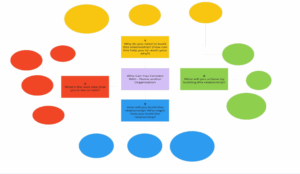 Use our relationship mapping template to:
-
- Identify current community relationships
- Name individuals and organizations you’d like to build deeper or new relationships with
Reflect on why each connection matters
3. Plan a Conversation
Choose one person or group from your map. Plan an informal, relationship-building conversation. This is about learning, not informing.
Ask yourself:
- Who from the community might I invite to co-lead this conversation?
- Should someone else schedule or facilitate it—especially if I’m not from the community I hope to connect with?
- How can we create a space that feels safe and respectful for all involved?
4. Focus on Learning, Not Library Services
Let the conversation center the community—not the library. Use open-ended, curiosity-driven prompts like:
- “What’s bringing joy—or challenge—to your community this summer?”
- “What kinds of experiences matter most to the folks you work with?”
- “What do you wish more institutions would ask or understand?”
- “What would a meaningful summer look like for your community?”
Use our note-taking template to record what you learn.
5. Return to Your Why
After your conversation, revisit the Why you created during the Five Whys activity.
Reflect:
- “What did I hear that connects to our Why?”
(e.g., “They shared how important it is to have free evening events for families.”) - “What did the conversation make me realize about our Why?”
(e.g., “We haven’t centered access or family time in our Why—we may need to.”) - “What might we shift, deepen, or add?”
(e.g., “We want to provide spaces that enable opportunities for intergenerational connection.”)
If you decide to revise your go back to your original Digging into Why template and revise your five Whys in that document. (Or if you would like to start from scratch, use the original template.)
6. Make Relationship-Building an Ongoing Practice
Transformational relationships grow over time. They’re not a one-time meeting or a project deliverable.
Keep asking:
- Who are we building with, and who is missing?
- Are we showing up with curiosity to learn about the other person or organization?
- Are we showing up with a commitment to continue to build the relationship instead of meeting once and being done?
- Are we deepening trust and thinking about transformation instead of focusing on the transactional, “What can we do together?”
 Measuring Progress
Often when thinking about summer services we look for signs of success. We look for higher numbers of registrants or higher numbers of people attending summer events and programs. Using numbers to define success and even focusing on success limits our ability to reflect on what went well and what might have been better. It focuses on the idea that we need to reach a particular goal instead of focusing on the way things have improved and what has helped us to get there. It also limits the ability to connect what we’ve achieved to our summer Why.
When thinking about progress you can celebrate the different ways you’ve been able to move community-based summer services forward. Progress can lead to success, and it’s important to value the steps you take to be successful. Progress can come in the form of learning from mistakes as well as seeing change in attitudes and behaviors.
Think back to your original Why and consider what you might look for to determine if you are making progress towards your summer Why. For example, if your summer Why is, ““To help youth and adults build relationships with each other,” ask yourself:
- How will I know that I am achieving that Why?
- What do I want to learn from youth, families, and adults to know I’ve made progress in reaching that Why?
Moving from a Focus on Success to a Focus on Progress
Step 1: Rethink “Success”
When you think of a “successful” summer, what comes to mind? Write down 3–5 things you would usually list as signs of success. (Examples: “Lots of people showed up,” “We got good feedback,” “We handed out all the reading logs”)
Now ask yourself:
- What do these signs of success actually measure?
- Who decided those things meant success?
- How do they help me to see if we are or aren’t reaching our summer Why?
Step 2: What does Progress Look Like
Think back to a moment when something you saw progress in something you worked on. Don’t worry if you thought it was successful, or special in some way. You want to think about something that felt like, “Oh, we moved forward through this work/activity.”
Write down what happened:
- What made it feel like progress?
- Who was involved?
- Why did it matter?
- What do you notice about what made thinking about progress instead of success different or helpful?
Step 3: Connect Progress to Your Summer Why
Write down your summer Why.
The table below shows you how to think about progress related to summer Why.
| Summer Why | What would progress look like? | How would I notice it or learn about it? |
| Example: “To help youth and adults build relationships with each other” | Adults and teens having conversations after events | I hear feedback or see people choosing to stay and talk |
Now think about what you might include in the table related to your summer Why. As you think about what progress looks like, ask yourself, “What will I hear or see or notice happening before, during or after the activity or service?” Use our template to begin to plan for looking for progress instead of success.
Reflection
Consider these questions:
- How does focusing on progress change how I think about summer planning?
- What might I do differently if I looked for signs of growth, not just numbers?
- What stories could I collect that show we’re moving toward our Why?
What is Building Community-Based Summers (BCBS)?
Building Community-Based Summers is a CSLP-sponsored six-session interactive discussion series held over the course of two months in Spring and Fall annually.
Apply Now for the Fall 2026 Cohort!
Applications for the Fall 2026 Cohort will be accepted July 24 through August 17, 2026. Apply here.
Applications are due by Monday, August 17, 2026 by 8:00 am ET.
- Fall Cohort Sessions take place Tuesdays, October 6, 13, 20, and 27 and November 10 and 17, 2026. An optional open discussion session will be scheduled on November 3.
- Sessions are 2 hours long: 1:00-3:00 pm ET / Noon-2:00 pm CT / 11:00 am-1:00 pm MT / 10:00am-Noon PT
- Please view the video below and read the BCBS FAQs (next tab) before applying.
BCBS is designed to help member libraries build strategies to engage community voices and provide summer services for all members of their communities. The discussions and activities will focus on how to connect with communities experiencing marginalization to design and implement summer library services. Selected participants will have the opportunity to engage with a nationwide cohort of library staff to dig deeply into inclusive summer services.
Past participants have shared about BCBS:
- “I found BCBS very insightful and helpful. We are changing things up! It was great to do the training with co-workers so we could rethink the way we do our summer programming.”
- “It was mind-opening and challenging in a positive aspect.”
- “Thank you for the experience! I enjoyed talking to other people from different libraries! It has expanded my knowledge and has changed my point of view on libraries and communities.”
This series is based on the Building Community-Based Summers framework, which has been developed as part of a grant from the Institute for Museum and Library Services.
Frequently Asked Questions
Who can participate?
BCBS is intended for CSLP member libraries. Any public library in a non-member state may join CSLP for a theme year. Library staff members at any level and in any department are eligible to apply. Multiple staff members at one library may apply together and participate as a team. Team participation can be beneficial as it allows for talking about and developing ways together for bringing community-based practices to your library.
This opportunity is open to all member libraries, and small and rural libraries are especially encouraged to apply!
How will participants be selected?
BCBS plans to build a cohort of CSLP libraries who are excited about having courageous conversations and thinking deeply about summer services.
Your library can be anywhere on the journey towards community-based summers. We are looking for thoughtful and candid responses to the application questions.
Applications are due by August 17. Selected participants will be notified in early September.
What am I committing to as a BCBS participant?
Participants will attend six interactive discussion sessions. For the Fall 2026 cohort, participants will commit to the following dates/times:
- Sessions take place Tuesdays, October 6, 13, 20, and 27 and November 10 and 17, 2026. An optional open discussion session will be scheduled on November 3.
- Sessions are 2 hours long: 1:00-3:00 pm ET / Noon-2:00 pm CT / 11:00 am-1:00 pm MT / 10:00am-Noon PT
Participants should have the ability to participate interactively with voice and video using Zoom. If possible, participants should attend from a private space, separate from others and away from interruptions. Please let us know in the application form if you will face any technical or institutional obstacles to any of the above.
Participants will commit to the BCBS Community Agreements, which include:
- Active engagement in conversations.
- Continual self-reflection.
- Readiness to have your ideas challenged.
Participants will spend time outside of learning sessions reflecting on learnings, incorporating ideas into practice, and sharing thoughts with other library staff and community members.
Participating in BCBS learning sessions requires about 2–3 hours per week, including time away from your regular duties. Time spent outside of learning sessions will focus on reflecting on learnings, incorporating ideas into practice, and sharing thoughts with other library staff and community members.
How do I make the case to my library leadership?
Share these findings that BCBS evaluators have collected to show the impact of participating in this discussion series.
Participants:
- Gain applicable knowledge. 94% of participants reported their intent to apply what they learned from the experience.
- Report increased confidence and action toward building community-based summers. After the discussion series, participants reported that they reimagined existing practices and goals of summer services; spent time outside the library building relationships; coordinated with civic and community partners; and worked to balance power in decision-making.
- Increase understanding of and knowledge about local communities. The majority of participants better understood the realities of groups experiencing marginalization in their community, including trusted community hubs and leaders, community demographics, family expectations and practices for summer, needs and challenges faced by youth and families, and community strengths.
- Strengthen their professional network. Participants deeply valued the opportunity to learn alongside colleagues from different libraries.
- Shift perspectives. Assessing existing library structures shifted participants’ ideas about what works for summer services within their libraries.
- Innovate summer services. Changes in library practice were most commonly seen in summer programming logistics, with libraries experimenting with more flexible, accessible, and community-centered approaches, such as: shifting participation models, offering more off-site programs, and simplifying registration processes. Progress was also made in building intentional community networks, as libraries made efforts to listen to and engage with community members experiencing marginalization.
If you would like more guidance in making the case for participation, contact [email protected] to reach out to the BCBS team.
Next: Acknowledgements
Acknowledgements
Many thanks to CSLP’s Building Community-Based Summers Committee for their continued volunteer work. In addition, thanks to project consultants, LaKesha Kimbrough and Linda W. Braun, for their expertise.
 Our BCBS Committee volunteers:
-
- Linda Braun
- Janet Ingraham Dwyer, Co-Chair
- Kate Greene Smith
- Corri Hines
- Katy Hite
- LaKesha Kimbrough
- Cathy Lancaster
- Caitlin Martin
- Jennifer Redford
- Jeni Schomber, Co-Chair
- Carrie Sanders
- Heather Warren Smith
- Sara White
Revised October 2025
CSLP has over 14,000 member libraries and is driven by over 200 library volunteers. As a membership-driven organization, everyone has an opportunity to participate and shape the future of summer programming and the Building Community-Based Summers (BCBS) program is just one of our many resources. CSLP is committed to providing resources, materials, and opportunities that reflect the diversity of our communities including all races, ethnicities, national origins, genders, and all other identities.
The views, findings, conclusions, or recommendations expressed in the Building Community-Based Summers program do not necessarily represent those of the Collaborative Summer Library Program.
Questions? Contact [email protected]